 service@coolienergy.com
 +86 189 0230 8582


Table of Contents
Hybrid Inverter vs Off Grid Inverter: Which Solar Inverter Is Right for Your System?
A hybrid inverter connects to the grid and a battery at once, switching seamlessly during outages, while an off grid inverter runs entirely on solar and battery power with no grid connection at all. The right choice depends on how reliable your local grid is and how much energy independence you need.

Why the Choice Between Hybrid Inverter and Off Grid Inverter Matters
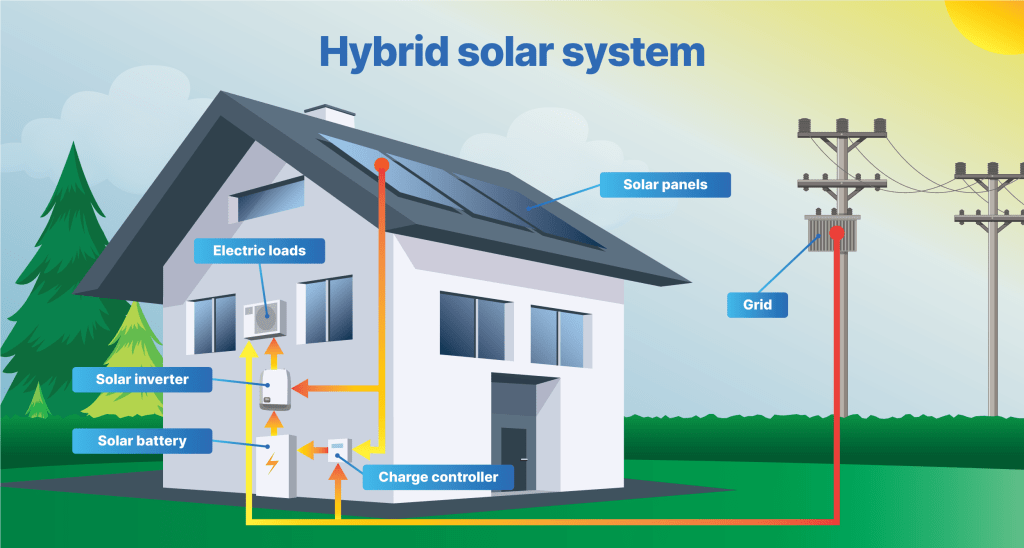
Choosing the correct solar inverter shapes your entire solar battery system — from installation cost to daily reliability. A hybrid inverter is designed to manage three energy sources simultaneously: solar panels, battery storage, and the utility grid. It automatically draws from whichever source is cheapest or most available, and switches to battery power within milliseconds if the grid fails.
An off grid inverter, by contrast, has no grid connection at all. Every watt used in the home must come from solar panels or the inverter battery system storing energy for later. This makes off grid systems the standard choice for remote properties, cabins, or regions where grid infrastructure doesn’t reach.
Understanding this core difference is the first step in matching the right solar inverter to your property, your budget, and your energy goals.
How Hybrid and Off Grid Inverters Actually Work
Hybrid inverter systems combine a solar charge controller, battery inverter, and grid-tie inverter into one unit. During the day, solar power charges the battery and runs the home; excess power can be exported to the grid or stored. At night or during outages, the battery discharges to keep essential loads running. Most hybrid inverters include automatic transfer switching, so backup power kicks in without any manual intervention.
Off grid inverters operate independently. They size battery capacity to cover multiple days of low sunlight (called “days of autonomy”) and typically pair with a backup generator for extended cloudy periods. Since there’s no grid to fall back on, the solar array and battery bank must be sized generously to avoid running out of power.
Benefits and Common Trade-Offs
Hybrid Inverter Advantages
- Seamless backup power during grid outages
- Lower battery capacity needed, since the grid acts as a backup
- Ability to sell excess solar power back to the grid in many regions
- Ideal for areas with an unstable grid — providing a reliable buffer when power fluctuates or cuts out
Off Grid Inverter Advantages
- Complete independence from utility companies and rising electricity rates
- No exposure to grid outages, since there’s no grid dependency at all
- Best fit for remote locations where grid connection is unavailable or prohibitively expensive
Common Trade-Offs
- Off grid systems require larger, more expensive battery banks
- Hybrid systems still depend on the grid for extended backup beyond battery capacity, unless oversized
- Off grid setups often need a backup generator for reliability during long low-sun periods
Best Practices for Choosing Your Solar Inverter
- Assess your grid reliability. If outages are frequent or the grid is genuinely unstable, a hybrid inverter with battery backup offers the best balance of cost and resilience.
- Calculate real energy needs. List essential loads (refrigeration, lighting, medical equipment) to size your inverter battery system correctly, whether hybrid or off grid.
- Check inverter capacity and battery compatibility. Match inverter output (kW) to your peak load, and confirm battery chemistry (lithium vs lead-acid) is supported.
- Factor in future expansion. Hybrid inverters generally make it easier to add panels or batteries later without redesigning the whole system.
- Compare total cost of ownership, not just upfront price — off grid systems cost more initially due to larger battery banks, but eliminate ongoing utility bills entirely.
- Work with a certified installer familiar with local grid codes, especially important across Africa and other regions with varying grid stability and net-metering rules.

FAQ
Is a hybrid inverter better than an off grid inverter? Neither is universally “better” — a hybrid inverter suits homes with grid access that want backup power and lower battery costs, while an off grid inverter suits properties with no grid connection at all.
What’s the best inverter for a battery storage system in Africa? In regions with frequent load-shedding or unstable grids, a hybrid inverter is often preferred because it combines solar, battery backup, and grid power, keeping essential loads running during outages while reducing battery bank size and cost.
Can I convert a hybrid inverter into an off grid inverter later? Many hybrid inverters can technically run off grid, but they usually require a larger battery bank and careful load management, since they weren’t originally sized for full independence.
How do I choose a solar inverter for a home battery system? Start by evaluating grid reliability in your area, your essential power needs, and budget — then match inverter capacity and battery type accordingly, ideally with guidance from a certified solar installer.
Conclusion
Both hybrid and off grid inverters offer dependable ways to pair solar power with battery backup — the right pick simply depends on whether you have (and want to rely on) a grid connection. If your grid is unstable but present, a hybrid inverter typically delivers the best balance of reliability and cost. If you’re building a fully independent system, an off grid inverter is the proven choice.
Ready to compare specific inverter models for your home or business? Talk to a solar specialist today to size the right hybrid or off grid inverter battery system for your needs.


